Car Logo Classifier & Intelligent Assistant
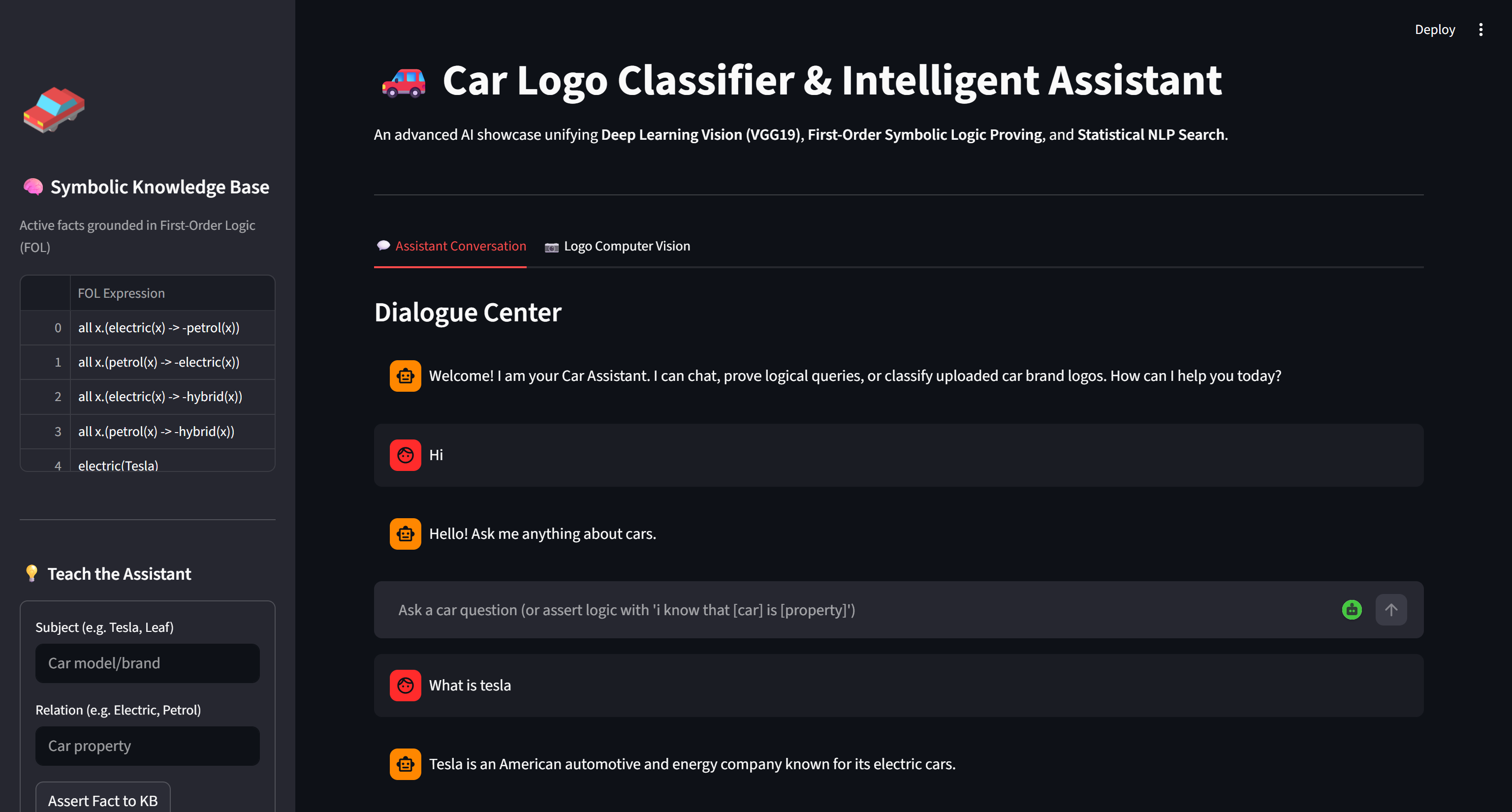
Developed as an intelligent, multi-modal automotive assistant, this advanced system unifies three distinct paradigms of artificial intelligence: Deep Learning computer vision, Symbolic First-Order Logic reasoning, and statistical Natural Language Processing (NLP). The chatbot allows users to interact seamlessly via conversational Q&A, query and expand an active First-Order Logic knowledge base with automatic consistency enforcement, and upload car logo images for instant brand identification with high neural network confidence scoring.
Core Features
Multi-Paradigm Conversational Interface
Integrates an AIML rule-based engine for structured dialogue routing, seamlessly falling back to statistical TF-IDF vectorization and Cosine Similarity search when phrasing variations are detected.
Deep Learning Logo Classification
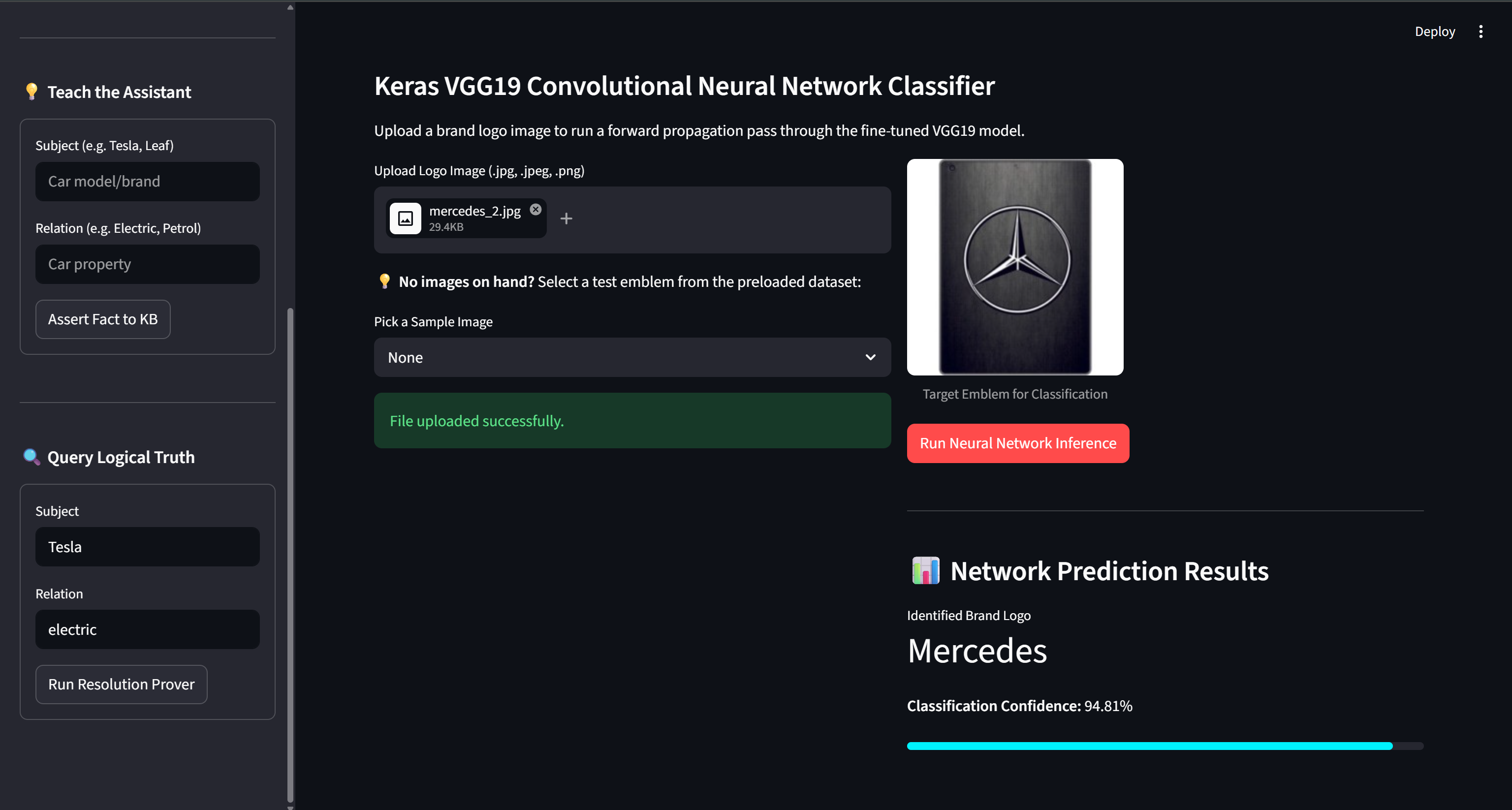
Features a fine-tuned CNN based on the VGG19 architecture using transfer learning, trained to identify 8 popular automotive brands (Hyundai, Lexus, Mazda, Mercedes, Opel, Skoda, Toyota, Volkswagen) with high-confidence predictions.
Symbolic Logical Reasoning
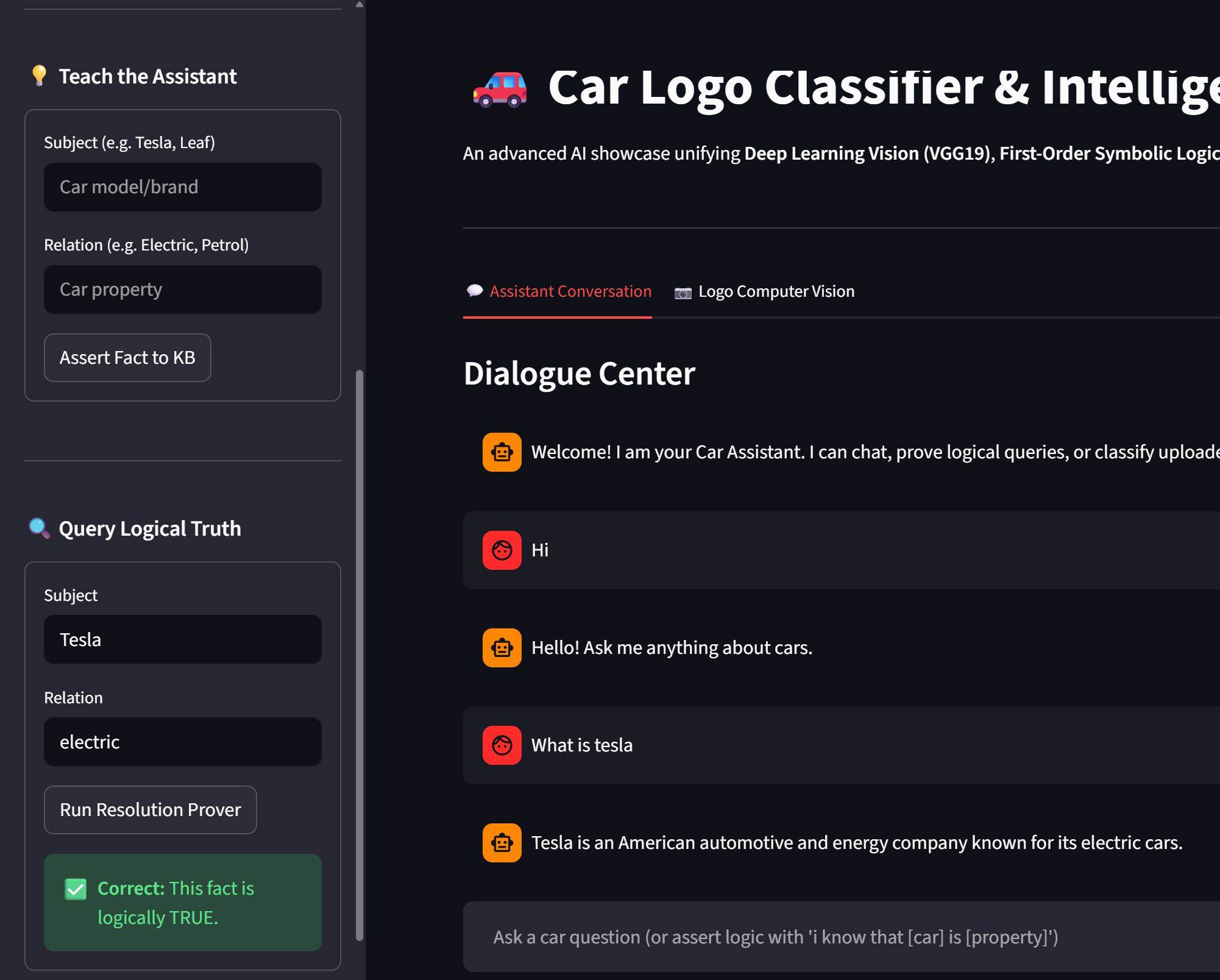
Built a First-Order Logic (FOL) knowledge base utilizing the NLTK ResolutionProver. Users can dynamically "teach" the chatbot facts (e.g., "I know that Tesla is electric") and verify details using natural language queries.
Automated Contradiction Resolution
Automatically evaluates new logical facts before saving them to the CSV knowledge base. The system uses resolution refutation to check for consistency and flatly rejects entries that contradict existing facts.
Background Preprocessing Pipeline
Leverages NLTK's tokenization and WordNet lemmatization to clean user inputs, improving semantic search and logic mapping accuracy across varied phrasings.
Technical Deep Dive
Convolutional Neural Network Transfer Learning (VGG19)
To achieve highly accurate brand logo classification, I leveraged transfer learning by fine-tuning a pre-trained VGG19 neural network on a curated dataset of automotive emblems. Input images are dynamically loaded, converted to RGB, resized to 128x128 pixels, normalized, and propagated through the convolutional layers. The final dense layer outputs a multi-class probability distribution across the 8 target brands, returning the identified brand along with a precise confidence percentage.
Symbolic Knowledge Consistency Checking
The logical reasoning engine represents automotive properties as first-order predicates (e.g., "electric(Tesla)", "-petrol(Tesla)"). When a user attempts to add new knowledge via "I know that [subject] is [relation]", the system performs a resolution proof against the negation of the new statement using NLTK's ResolutionProver. If the prover successfully derives a contradiction from the existing knowledge base, the system prevents logical corruption, logs an alert, and rejects the input, ensuring 100% database integrity.
Statistical Semantic Alignment & Fallback
To bridge the gap between fixed-rule AIML matching and arbitrary user inputs, the NLTK pipeline preprocesses, tokenizes, and lemmatizes queries into canonical word roots. By generating high-dimensional TF-IDF vectors for both the user input and the pre-defined Q&A dataset, the engine computes a Cosine Similarity matrix in real-time. If the similarity score of the best-matching Q&A pair exceeds a threshold of 0.7, it returns the factually correct answer, completely preventing common conversational failures.
Performance Benchmark
"Engineered a multi-modal intelligent assistant that successfully bridges deep learning computer vision, symbolic logical reasoning (FOL) with automated consistency checking, and statistical NLP, maintaining 100% database integrity under conflicting inputs."